%20of%20wildflowersbar.JPG)
Learning the basic family characteristics
of flower groups will provide a general familiarity with wildflowers
throughout the Rocky Mountains. Knowing the general characteristics
of these families, including the Lily, Buttercup, Rose, Mint, Pea and
Sunflower families, will ease the confusion of differentiating one species
from a thousand or more species within a full color spectrum.
Each family has several characteristics
that identify it. The main characteristics to look for in a flower are
shape and structure-how the flowers and leaves are arranged, the number
of flower parts, sepals, petals, stamens and ovaries. Also look at the
symmetry of a flower. When you draw an imaginary line vertically through
a flower, does it produce two mirror images or two different lopsided
images? The fusion of floral parts, whereby similar flower parts fuse
together to form one unit like a trumpet- or funnel-shaped flower, and
whether the flower is superior or inferior, also are good distinguishing
indicators. The flower is superior when the ovary is in the center
of the flower with all the other parts attached to its base. It is inferior when the flower parts are attached at the top of the ovary.
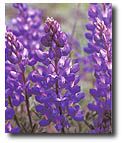 Members
of the Lily Family (Liliaceae) have parts in threes: three sepals-which
may look like petals in some species, give the appearance of six petals;
three petals; six stamens; and an ovary with three chambers. Members
of the Buttercup Family (Ranunculaceae) have simple structures in which
the sepals and petals are separate and distinct, not fused, with numerous
stamens and many separate ovaries. While the Rose Family (Rosaceae)
has similar features, it is distinguished by the fact that the bases
of the sepals, petals and stamens join to form a cup, or hypanthium,
around the ovary or ovaries. Members of the Mint Family (Lamiaceae,
once called Labiatae) are distinguished by their four-sided, square
stems, opposite leaves, minty aroma and technical features of two or
four stamens, plus an ovary that is divided into tour hard segments,
or nutlets. Members of the Pea Family (Fabaceae, once called Leguminosae)
are easy to recognize by their distinctive, irregular corollas. These
corollas are comprised of five united petals forming a banner, two wings
and two lower petals joined to form the keel, plus one pistil that develops
into a single-celled pod called a legume. The most complex group is
the Sunflower or Composite Family (Asteraceae, once called Compositae).
This large group offers the most difficulty when distinguishing individual
members. What appears to be a single flower actually is a composite
of hundreds of individual flowers. Forming the outside ring on a typical
sunflower are ray flowers, and the inner cluster consists of disk flowers.
Each individual disk flower bears an inferior ovary that produces a
single seed Members
of the Lily Family (Liliaceae) have parts in threes: three sepals-which
may look like petals in some species, give the appearance of six petals;
three petals; six stamens; and an ovary with three chambers. Members
of the Buttercup Family (Ranunculaceae) have simple structures in which
the sepals and petals are separate and distinct, not fused, with numerous
stamens and many separate ovaries. While the Rose Family (Rosaceae)
has similar features, it is distinguished by the fact that the bases
of the sepals, petals and stamens join to form a cup, or hypanthium,
around the ovary or ovaries. Members of the Mint Family (Lamiaceae,
once called Labiatae) are distinguished by their four-sided, square
stems, opposite leaves, minty aroma and technical features of two or
four stamens, plus an ovary that is divided into tour hard segments,
or nutlets. Members of the Pea Family (Fabaceae, once called Leguminosae)
are easy to recognize by their distinctive, irregular corollas. These
corollas are comprised of five united petals forming a banner, two wings
and two lower petals joined to form the keel, plus one pistil that develops
into a single-celled pod called a legume. The most complex group is
the Sunflower or Composite Family (Asteraceae, once called Compositae).
This large group offers the most difficulty when distinguishing individual
members. What appears to be a single flower actually is a composite
of hundreds of individual flowers. Forming the outside ring on a typical
sunflower are ray flowers, and the inner cluster consists of disk flowers.
Each individual disk flower bears an inferior ovary that produces a
single seed
"The Essenstials for
Planning your
Trip to Yellowstone Park" |
|
|
|
|
When you identify a plant family, the
next step is to determine the genus, grouped under families. Again,
these will have similar and more defined characteristics. Determining
the genus of a species may be more than adequate because it might be
difficult to determine individual species in some instances. Many groups
or genera, especially in the pea family, are difficult to identify to
species without knowing the minute technical features or finding the
plant in the appropriate flowering or seed stage. Determining the correct
group or genus usually is sufficient in identifying a flower in the
field.
In helping to identify a flower, look
for distinguishing characteristics, such as the habitat in which the
flower is found; the type of root system; plant size, stem structure;
leaf arrangement and shape; flowering arrangement or type of inflorescence;
color, numbers and arrangement of sepals, petals and other floral parts;
and the type of fruit it produces.
Roots are the fundamental anchoring system
and the means through which water and nutrients are absorbed and sometimes
stored. A root also can help determine whether a plant is an annual
or perennial. Plants with fibrous roots generally are annuals,
especially those with less-extensive root systems. Fibrous roots also
tend to be irregularly branched.
Taproots tend to have a main, stout axis extending vertically, and often bear
smaller lateral roots. This central axis often can be thickened by storage
of food. A carrot is an example of a taproot. Many annuals and biennials
and some perennials have this type of root system.
More specialized root systems include corns, bulbs, rhizomes and tubers. All these are underground
modified stems that serve as food storage and often aid in reproduction.
The stem is the axis of the plant
from which all other parts arise. Along the stem are joints, called
nodes (the space between nodes are called internodes), and from these
branches, leaves and sometimes roots grow as buds. If there is only
one leaf to a node, it is arranged stem. If there are two leaves at
each node, they are arranged oppositely on the stem. And if there
are more than three leaves to a node, they are arranged in whorls. The angle formed by the stem and leaf stalk is called the axil, and buds formed in the axils are called axillary buds.
 A
leaf can be an important aid in identifying a flower. Each leaf consists
of a stalk (petiole), a blade, and sometimes stipules, orwinglike appendages atthe base of certain leaves. In some instances,
the petiole is absent and the leaf then is sessile on the stem.
Leaves can be either simple or compound. For a simple leaf, the
blade consists of a single piece. A compound leaf is composed
of many small leaflets, arranged either pinnatelyatong a central stalk, or attached at the end of a stalk that spread pa/mate/ylike
fingers. Leaflets never have axillary buds, but compound leaves always
have one at the base. Leaves growing at ground level and appearing to
rise from one source are called basa/ leaves and often form a cluster,
or rosette. A
leaf can be an important aid in identifying a flower. Each leaf consists
of a stalk (petiole), a blade, and sometimes stipules, orwinglike appendages atthe base of certain leaves. In some instances,
the petiole is absent and the leaf then is sessile on the stem.
Leaves can be either simple or compound. For a simple leaf, the
blade consists of a single piece. A compound leaf is composed
of many small leaflets, arranged either pinnatelyatong a central stalk, or attached at the end of a stalk that spread pa/mate/ylike
fingers. Leaflets never have axillary buds, but compound leaves always
have one at the base. Leaves growing at ground level and appearing to
rise from one source are called basa/ leaves and often form a cluster,
or rosette.
Leaves and leaflets come in a vartety
of shapes and forms. The most common outlines or shapes of a blade are lanceolate (shaped like the tip of a lance), ovate (egg-shaped,
with a pointed tip), linear (line-shaped), spatulate (spatula-shaped), heart-shaped, arrow-shaped or round. Some descriptions
will have the Gree^ prefix ob- attached to it, describing that
it is in a reverse direction. In addition, leaf margins or edges can
be smooth, or entire, scalloped, serrate, deeply lobed, toothed, or even double toothed.
Another distinguishing feature for leaves
is the type of venation. Most monocots, such as grasses and lilies,
have parallel venation, in which the veins, orvascular ridge
on a leaf, extend the length of the leaf and parallel each other and
the leaf margin. Dicots, on the other hand, have netted venation, whereby veins branch and form a netted pattern. Most palmately lobed
leaves are palmately veined, a pattern like the fingers
on a hand.
 The
flowering cluster or its arrangement on the axis is called the inflorescence. If only one flower appears at the end of a stalk, it is called a solitary inflorescence. If the plant is unbranched and the flowers appear to
lack flower stalks (pedicels), it is a spike; the white bog-orchid
is a good example. If the flowers have stalks, it is a raceme, the most common form of inflorescence. If the raceme is irregularly
or alternately branched, it is a panicle. If it is oppositely
and regularly branched, it is a cyme. If all the flower stalks
(pedicels) arise form one point and are equal in length, it forms an umbel, and multiple branching forms a compound umbel, such as
cow parsnip. But if the flower stalks arise from different positions
on the axis and are different lengths but arrive at the same level and
appear flat-topped, it is a corymb. In the case of the Sunflower
Family (Asteraceae), a cluster of numerous, tiny flowers form a button-like head. A head generally is composed of two types of flowers-the
outside ring of usually colorful ligules or ray flowers and the inner tubular or disk flowers. The
flowering cluster or its arrangement on the axis is called the inflorescence. If only one flower appears at the end of a stalk, it is called a solitary inflorescence. If the plant is unbranched and the flowers appear to
lack flower stalks (pedicels), it is a spike; the white bog-orchid
is a good example. If the flowers have stalks, it is a raceme, the most common form of inflorescence. If the raceme is irregularly
or alternately branched, it is a panicle. If it is oppositely
and regularly branched, it is a cyme. If all the flower stalks
(pedicels) arise form one point and are equal in length, it forms an umbel, and multiple branching forms a compound umbel, such as
cow parsnip. But if the flower stalks arise from different positions
on the axis and are different lengths but arrive at the same level and
appear flat-topped, it is a corymb. In the case of the Sunflower
Family (Asteraceae), a cluster of numerous, tiny flowers form a button-like head. A head generally is composed of two types of flowers-the
outside ring of usually colorful ligules or ray flowers and the inner tubular or disk flowers.
Most flowers consist of four series of
parts. The outside series or ring usually is green, but in lilies, this
series may be colored, is called the calyx, and is comprised
of sepals. Within the calyx is the corolla, comprised
of the highly colorful and showy petals. The terms calyx and
corolla generally are used when they are united, forming bell- or funnel-shaped
flowers. The calyx and corolla together are called the perianth. The next series just inside the petals are stamens. Each stamen
consists of a relatively slender stalk, called the filament, tipped with a pollen-bearing anther. The stamens can be either
separate, united to each other, or fused to other floral parts.
In the very center of the flower, or
the innermost series, is one or more pistils. The pistilcan be
either simple or compound and is composed of a swollen base, the ovary,
a slender, sometimes branched sf/te, topped with a stigma, which receives pollen. Inside the ovary are ovules that, when
fertilized, develop into seeds. A carpel's a structure of the
pistil and is said to be compound if it is composed of two or more united
carpels. Ovules usually are borne along the margins of a carpel.
After the ovules have been fertilized,
the ovary and other parts associated with it begin to ripen into a fruit to aid in distribution of seeds. The most common form is a hardcased,
one-seeded fruit called an achene. Most members of the Sunflower
Family produce achenes. Another type of dry fruit is a dry capsule, produced by some members of the lilies and as follicles in columbines.
Fleshy fruits are derived from various
structures of the flower. A pome represents a fruit in which
the calyx enlarges and encloses the ovary; apples and serviceberries
are examples. Other fleshy fruits include strawberries, in which the
receptacle enlarges and each ovary has an achene attached to it. A fruit
in which the outer seed coat becomes fleshy is called a drupe; plums are an example. It is typical of raspberries for clusters of small
drupes, called drupelets, to attach to the receptacle but separate
when ripe. True berries are soft fruits with seeds embedded in
the pulp, like huckleberries.
The Wildflowers Directory is from the
excellent field guide "Wildflowers
of the Rocky Mountains" by Carl Schreier
|