%20of%20snowcoachbar.JPG)
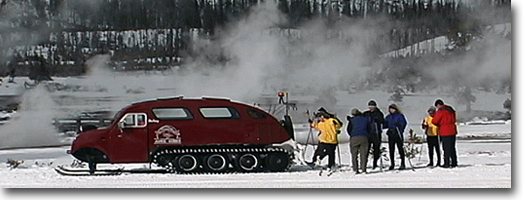
Snowcoach tours are an alternate way
to see Yellowstone National Park. The snowcoach offers
the convenience of viewing the natural wonders while just sitting back
and relaxing in an enclosed heated cab while your driver delivers park
information as you cruise along the scenic routes. Many of the Yellowstone
Snowcoach operators offer guided tours that include skiing, snowshoeing
and lunch. The following tours are available from the snowcoach operator.
These tours are also available by licensed snowmobile operators.
If you wish you can go straight to the Snowcoach
Operators in Yellowstone National Park by clicking
this link.
WEST ENTRANCE TO MADISON JUNCTION (about14 miles):
The road closely follows the Madison
River and allows you to view the Madison Plateau to the south and the
rim of the Yellowstone Caldera to the north. Geological landmarks include
Mount Haynes, Mount Jackson, and National Park Mountain. In & near the
Madison River you may see waterfowl, including: Ducks (Golden Eye, Merganser,
Mallard, Coots, and others,) Geese (Greater & Lessor Canada, Snow, and
others,) & Trumpeter Swans, being the most common. Maternity herds and
bachelor groups of Bison feed all winter in the meadows adjacent to
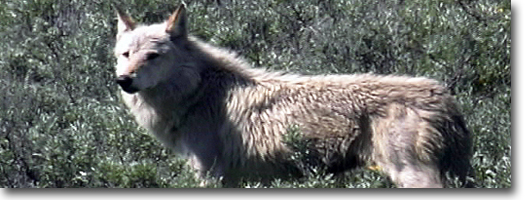
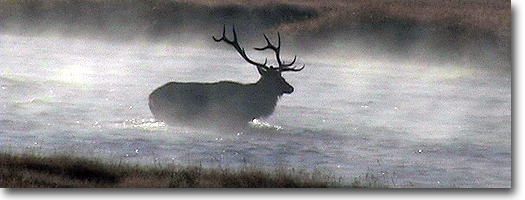
the river, as do both cow and bull Elk. Wolves and Coyotes frequent
this area too, along with animal tracks, elk and bison beds. Restrooms
are located at Seven Mile Bridge and at the Warming Hut at Madison Junction.
MADISON JUNCTION TO NORRIS GEYSER
BASIN (about 14 miles)
The road gently climbs the inside of
caldera rim and follows 
the Gibbon River to Gibbon Falls, then through the Gibbon Canyon to
gibbon Meadows, Elk meadows, and finally Norris Junction. Along the
way you may see Beryl Spring, Elk and Bison, Coyotes, Eagles, Ravens,
Geese, Ducks, and occasionally other birds or mammals. A short hike
from the road are the Artist's Paint Pots. Restroom are located at Norris
Geyser Basin.
NORRIS GEYSER
BASIN
Contains two distinct basins of different
character: the Back
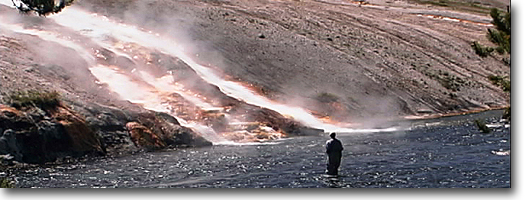
Basin & Porcelain Basin. These basins are the hottest and
most geologically active geyser basins in Yellowstone and are constantly
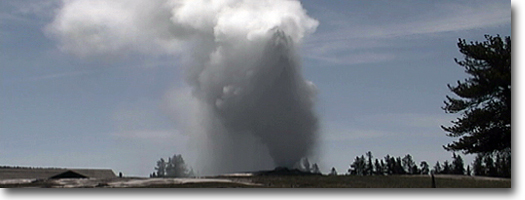
changing. The attractions in the Back Basin include: Steamboat Geyser
(world's tallest active geyser,) Echinus Geyser (erupting at near regular
intervals of 30-60 minutes, for up to one hour, and heights to 60 feet,)
Minute geyser, Green Dragon Spring (with boiling green water in a sulfur-lined
cave,) Porkchop Geyser (currently a boiling hot spring, but with a history
of explosive eruptions.) The attractions in the Porcelain Basin include:
Porcelain Springs, Whirligig Geysers, Ledge Geyser, Blue Geyser, Black
Growler, and many hot springs that are acidic and arsenic rich. The
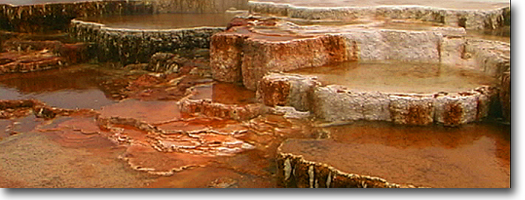
various colors that are found in, and around the edges of the hot springs
are the result of the minerals such as iron and arsenic combining in
a myriad of compounds. Additionally the lime-green Cyanidium algae thrive
in this environment along with cyanobacteria that is orange and brown.
MADISON
JUNCTION TO OLD FAITHFUL (about 16 miles):
The road gently climbs out of the Madison
River Valley to the three most visited geyser basins in the park (Lower,
Midway, Upper.) The road follows the Firehole River, past Firehole Falls
in the Firehole Canyon , through a gently broken valley to Old Faithful.
Restrooms are located at Fountain Paint Pots, Bisquit Basin, and Old
Faithful. Located less than a mile from Madison Junction is Firehole
Canyon Drive. This road follows the stream bank of the Firehole River
in its narrow canyon and abruptly climbs to the top of Firehole Falls.
If you make your own Christmas cards this picturesque drive will provide
you with spectactular scenes. Above the falls Firehole canyon widens
rapidly into the Firehole valley and wildlife viewing opportunities
abound. Ducks, Geese, Dippers, Swans, Elk, Bison, Wolves, Coyotes, Woodpeckers,
Eagles, Deer, Hares, Porcupines, Ravens, Mice, Martens, and other animals
may be seen along this stretch of road all winter.
Lower
Geyser Basin
About half way to Old faithful and the
most popular attractions in this basin are located at Fountain Paint
Pots. With just a short walk it is possible to see all four types of
the parks thermal features (Hot Springs, Fumaroles, Mud Pots, Geysers.)
Silex Spring is a classic hot spring with attendant features of color,
temperature, biota, and spectacle. Be sure to look closely at the bacterial
and algae mats for flies that subsist only on this food, and the spiders
that subsist only on the flies. These life forms are the food source
for mites, mice, insects, and birds. Fountain Paint Pot is usually best
viewed in winter when the water table, and local snow melt combine to
produce perfect conditions for the display of the world famous 'bubbling
mud.' Red Spouter is a recent feature that developed in 1959 after the
Hebgen Earthquake. In the summer it is just an ordinary fumarole, but
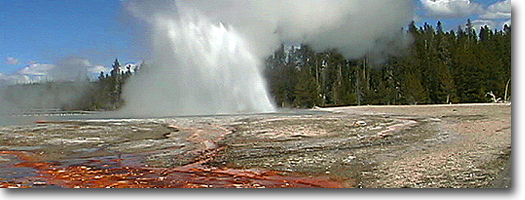
in the winter it spouts red water and red mud. Clepsydra Geyser is a
spectacular sight and the boardwalk allows visitors to get an up-close-and-personal
view of this feature. Lucky visitors will have the chance to see Fountain
Geyser, a spectacular display of several related geysers erupting in
a wild symphony of sights, sounds and spray. Don't let the silica-rich
waters get on your camera lenses!
Midway
Geyser Basin
About 2 miles south of Fountain Paint
Pot. Excelsior Geyser 
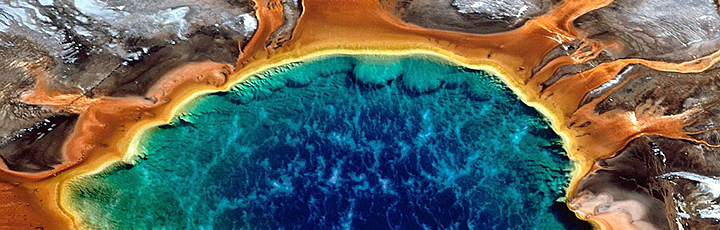
and Grand Prismatic Hot spring (the largest hot spring in the
park,) are the main attractions in this basin. Upper Geyser Basin is
a collection of three conjoined sub-basins surrounding the Old Faithful
area (Biscuit Basin, Black Sand Basin, Old Faithful Basin.) This part
of Yellowstone contains the largest concentration of geysers in the
world. The geysers have been combined by proximity, geologic, and topographic
criteria into groups. All the groups are accessible in the winter.
Biscuit Basin is formed by the
confluence of the Firehole River and Iron Spring Creek. It is a meadow
that attracts large animals and waterfowl in the winter because of the
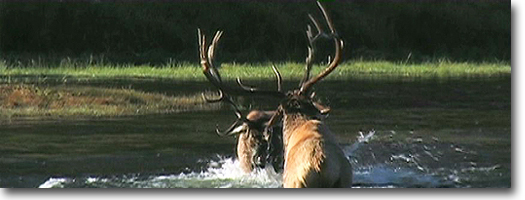
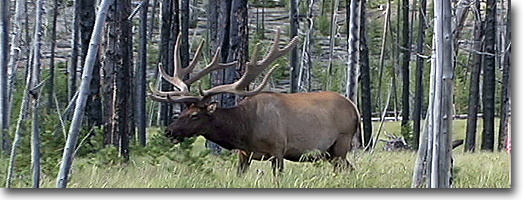
heat and available forage. It is common to see large bull elk and giant
bull bison grazing side by side in this lush meadow. The visitor with
a sharp eye will also be able to identify many shore birds, waterfowl,
and scavengers around the edges of the grazing herds. Thermal attractions
in this area include: Sapphire Pool, Jewel Geyser, Mustard Spring, Avoca
Spring, and Shell Geyser. 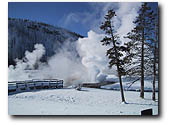
Black Sand Basin derives its name
from the concentration of black
obsidian (volcanic glass,) sand in the basin.Two
large hot springs (Emerald Pool
& Rainbow Pool,) are located here. Sunset Lake (a hot spring that behaves
like a geyser,) Cliff Geyser, Spouter Geyser, and Opalescent Pool are
also located here.
Upper Geyser Basin
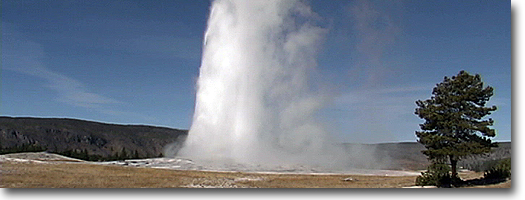
Old Faithful Basin contains five major
geyser groupings, each is named for the signature geyser(s) in the group.
Visitors with time to enjoy thermal features should spend some time
with each group.
Geyser Hill Group: Old faithful, Anemone
Geyser, Plume Geyser, Beehive Geyser,
Lion Group, Giantess Geyser, Heart Spring,
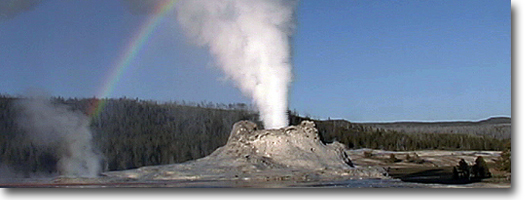
Solitary Geyser, and Doublet Pool. Castle-
Grand Group: Castle Geyser, Grand Geyser,
Spasmodic Geyser, Sawmill Geyser, and Crested Pool.
Giant-Grotto Group: Giant Geyser, Grotto
Geyser, Beauty Pool, Chromatic Spring, Oblong Geyser.
Daisy Group: Daisy Geyser, Splendid Geyser,
Comet Geyser, Black Sand Spring, and Punchbowl Spring and is a popular
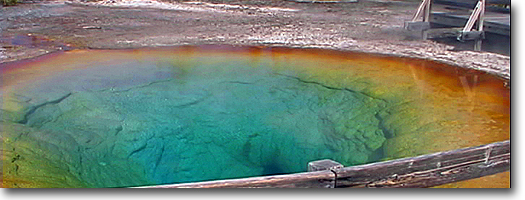
place for scenic photography. Riverside-Morning Glory Group: Riverside
Geyser, Morning Glory Pool, Gem Pool, Artemisia Geyser.
OLD FAITHFUL
TO WEST THUMB GEYSER BASIN(about 17 miles):
The road climbs steeply from Old Faithful
to the top of the 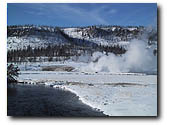
Madison Plateau, past Kepler Cascades, and then over Craig
Pass (elevation 8,262'asl,) then down to the West Thumb Geyser Basin.
The visitor crosses the continental divide twice on this journey and
the bridge at Isa Lake allows the imagination to wander because this
little body of water drains both east and west, feeding water into both
the Atlantic and Pacific Oceans. Restrooms located at West Thumb. This
Geyser basin is better known for its pools than its geysers. Although
there are about a dozen identified geysers in a concentrated area, their
activity has declined greatly since the 1970's. Additionally, the tectonic
activity of the Yellowstone Lake region has conspired to inundate and
drown several significant thermal features here. The north shore of
the lake basin is raising and the water is moving to the south and filling
the West Thumb basin as it does. Many of the inundated features lie
within sight of the shore and as deep as 10-20 feet. Activity in the
form of bubbles can be seen when the lake is calm, and in the winter
holes in the ice are occasionally seen. There are two main groupings
of geysers in this geyser basin: The Lower Group and The Upper Group.
Both groups are easily accessible in the winter. Lower Group: Twin Geysers,
Roadside Steamer Pool, Abyss Pool, Black Pool, King Geyser, Fishing
Cone (one of the most famous hot springs in Yellowstone is cooling rapidly,)
Thumb Geyser, and Surging Spring are the prominent features of this
group.
Lake Shore Group: Occasional Geyser,
Lone Pine Geyser, Blowhole Spring, Overhanging Geyser are the significant
features of this concentrated group of thermal features.
WEST THUMB
TO FISHING BRIDGE (about 22 miles): The road provides a pleasant
journey along the shore of Yellowstone Lake, through occasionally very
dense forest of pine and fir. Vast panoramas are available for the photographer.
Restroom located at fishing bridge.
FISHING BRIDGE TO CANYON JUNCTION (about 17 miles):
Six or seven miles north of Fishing Bridge
along a scenic climb and descent into the Hayden Valley is the Mud Volcano
Area. This area is often described by visitors as 'hot, stinking, violent,
scary.' This region is adjacent to one of the major vents from the collapse
of the Yellowstone caldera about 600,000 years ago. This region is so
active that the parking area is constantly being repaired. The Mud Volcano
Area contains 11 significant features most of which are mud pots of
various kinds. There is also a rare feature, the Mud Geyser it is currently
experiencing a period of quietude but the turbulence at the south end
of the bubbling pool may signify a coming resurgence. The discharge
from Sulfur Caldron is about the same acidity as battery acid (pH of
1.2,) and the striking yellow color attests to its high sulfur content.
If you want photographs of other-worldly scenes this is the place to
take them. Visitors enjoy the memorable names of this area: Dragon's
Mouth Spring, Sour Lake, Churning Caldron, Sizzling Basin, Cooking Hillside
(soil temperatures as hot as 200 F.) Continuing north throught the Hayden
valley the visitor experiences pastoral winter scenes in this vast and
rich valley. Stray coyotes, giant bull bison, occasional ravens, infrequent
elk, solitary eagles, and snowshoe hares puntuate the expansive valley.
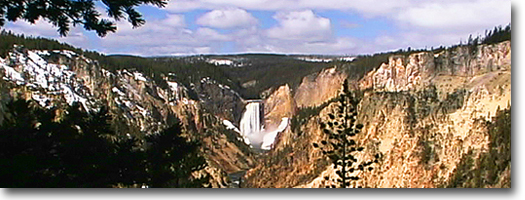
At times the horizons seem endless, at others the Yellowstone River
carves graceful curves on its way to the thundering falls at Canyon
Junction just eight or nine miles north of Mud Volcano. Restrooms at
Canyon Junction.
CANYON JUNCTION
TO NORRIS JUNCTION (about 12 miles):
A winding mountain road through a pine-fir
forest puntuated in winter by the occasional giant bull bison, a few
small hot springs, and a scenic loop road at virginia cascades. Restrooms
at canyon junction.
NORRIS JUNCTION
TO MAMMOTH HOT SPRINGS (about 21 miles): Just north of the
meadows at Norris junction the road climbs the divide between the Gibbon
River drainage and the headwaters of the Gardner River. Five or six
miles into this journey the visitor finds Roaring Mountain. This steaming
mountain side occasional draws small groups of elk and bison because
of its warmth. The rest of the journey is a gentle descent toward the
upper terraces of Mammoth Hot Springs where over-the-snow travel ends.
The upper terraces are available to the winter visitor. The lower terraces
are available to conventional vehicular travel.
Snowcoach
Operators in Yellowstone National Park
Yellowstone
Alpen Guides
P.O. Box 518
West Yellowstone, MT 59758 |
Yellowstone
Expeditions P.O. Box 865
West Yellowstone, MT 59758 |
Yellowstone Tour & Travel
P.O. Box 410
West Yellowstone, MT 59758 |
SnoVans
of Yellowstone
P.O. Box 1140
300 Madison Avenue
West Yellowstone, Montana |
International
Leisure Hosts Ltd./Flagg Ranch
PO Box 187
Moran WY 83013 |
Rocky Mountain Snowmobile
Tours
1050 South Highway 89 P.O. Box 820
Jackson, Wyoming 83001
|
Lone
Mountain Ranch
Box 160069
Big Sky, MT 59716 |
Amfac
Parks & Resorts
P.O. Box 165
Yellowstone National Park, Wyoming 82190 |
Stagecoach
Inn
209 Madison Ave.
West Yellowstone, MT. 59758 |
|
|